

Developing solutions together with our customers
At Fonderie Ariotti, research and development is driven by the real engineering challenges our customers face. In this update, we share some of the main R&D activities carried out during 2025 and the projects currently underway for 2026. At the same time, we would like to understand which topics are most relevant for you, because collaboration with our customers plays a key role in guiding our future research.
Tell us which of our 2025-26 R&D activities you’d like to explore in more depth:
Advanced mechanical and fatigue characterisation beyond EN 1563
Optimised ductile iron for low-temperature applications
Stainless steel cladding for higher corrosion resistance and hardness
Finite Element Analysis (FEA) & integrated co-design approach
3D-printed cores and moulds for complex geometries
High-temperature oxidation behaviour of cast irons
Effect of overloads on residual fatigue properties
Corrosion-fatigue behaviour and cathodic protection studies
Thanks for your feedback. It helps us align our research with our customers’ needs and collaborate in the same direction.
Research and development activities – 2025
At Fonderie Ariotti, research and development activities are focused on improving materials knowledge,process control, and engineering support for customers. In 2025 and 2026, our work has primarily focused, and will continue to focus, on the following topics:
Improved material performance at low temperature through optimised production process.
Stainless steel cladding for higher corrosion resistance and hardness.
Advanced metallurgical and mechanical characterisation of thick-walled ductile cast iron.
Integration of finite elements analysis for co-design with customers.
- Investigation of material behaviour in demanding service conditions.
Below is an overview of the main activities carried out during 2025, followed by the research projects currently underway for 2026.
Optimisation of ductile cast iron for low-temperature applications
For components operating in low-temperature environments, EN 1563 specifies the grades EN-GJS-400-18-LT and EN-GJS-350-22-LT, which require tensile tests at room temperature and Charpy impact tests at –20 °C and –40 °C.
During 2025, we developed an optimised production process aimed at improving the impact performance of these materials. Test samples were cast and machined according to EN 1563, and impact testing was extended to temperatures down to –70 °C to better study the ductile-to-brittle transition behaviour.
The optimised process showed significantly improved results, achieving the required mean impact energy even at –60 °C. Tensile tests also demonstrated improved elongation after fracture, confirming the enhanced ductility of the material.


Stainless steel cladding of castings
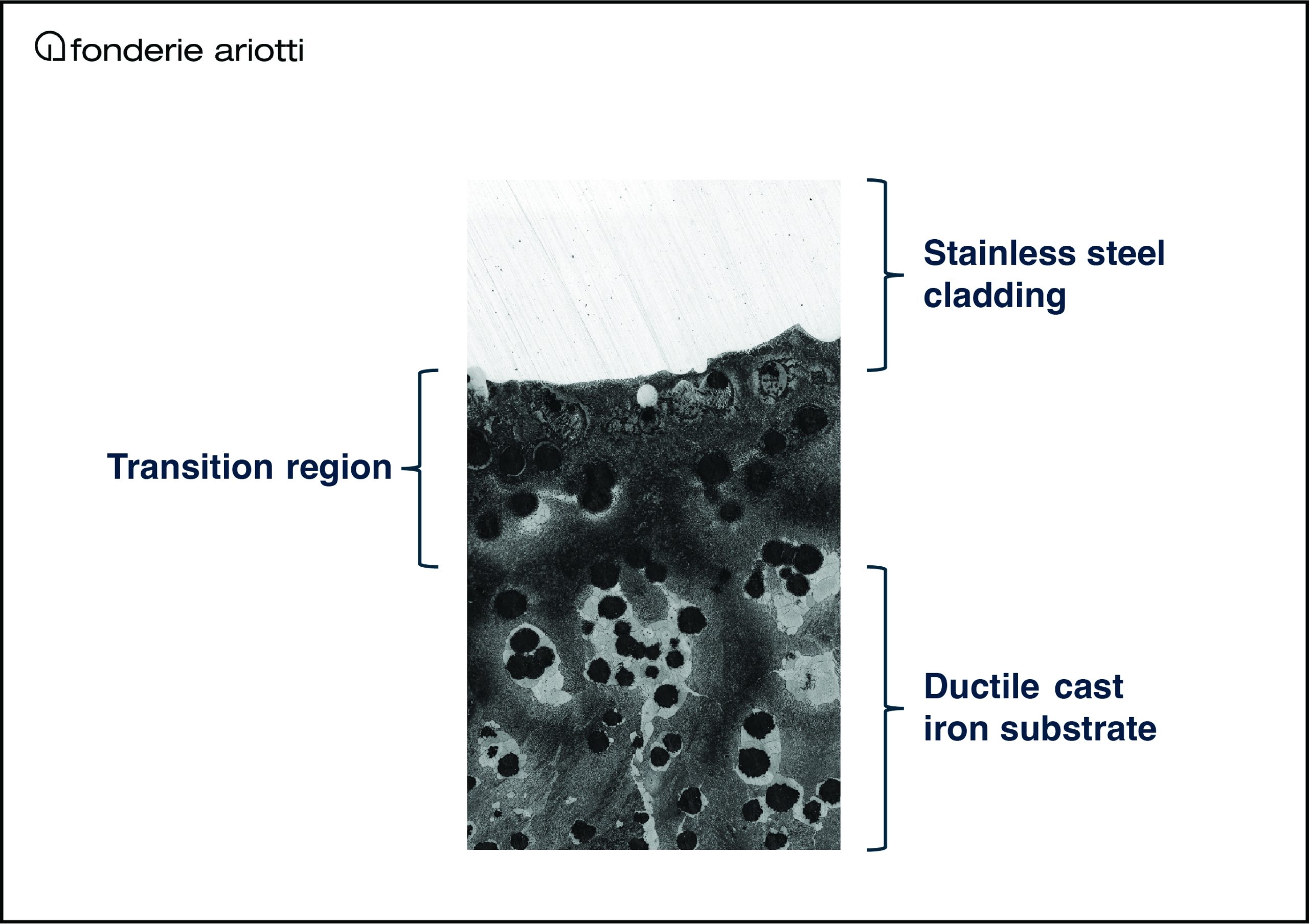
When enhanced corrosion resistance and surface hardness are required, stainless steel cladding offers an effective solution to improve these properties in selected areas of ductile iron castings.
The process consists of welding stainless steel filler material onto rough-machined castings, followed by finish machining. The deposited layer is typically AISI 307 stainless steel, characterised by an austenitic microstructure, higher corrosion resistance compared to ductile cast iron, and a typical hardness of 200–230 HB.
Further studies are ongoing to evaluate alternative stainless steel grades aimed at improving surface hardness and wear resistance.

Advanced metallurgical and mechanical characterisation of ductile cast iron beyond standards
During 2025, we continued expanding our mechanical and metallurgical database for ductile cast iron beyond current standards. For example, EN 1563 provides tensile properties only for limited wall thickness ranges and only indicative fatigue data.
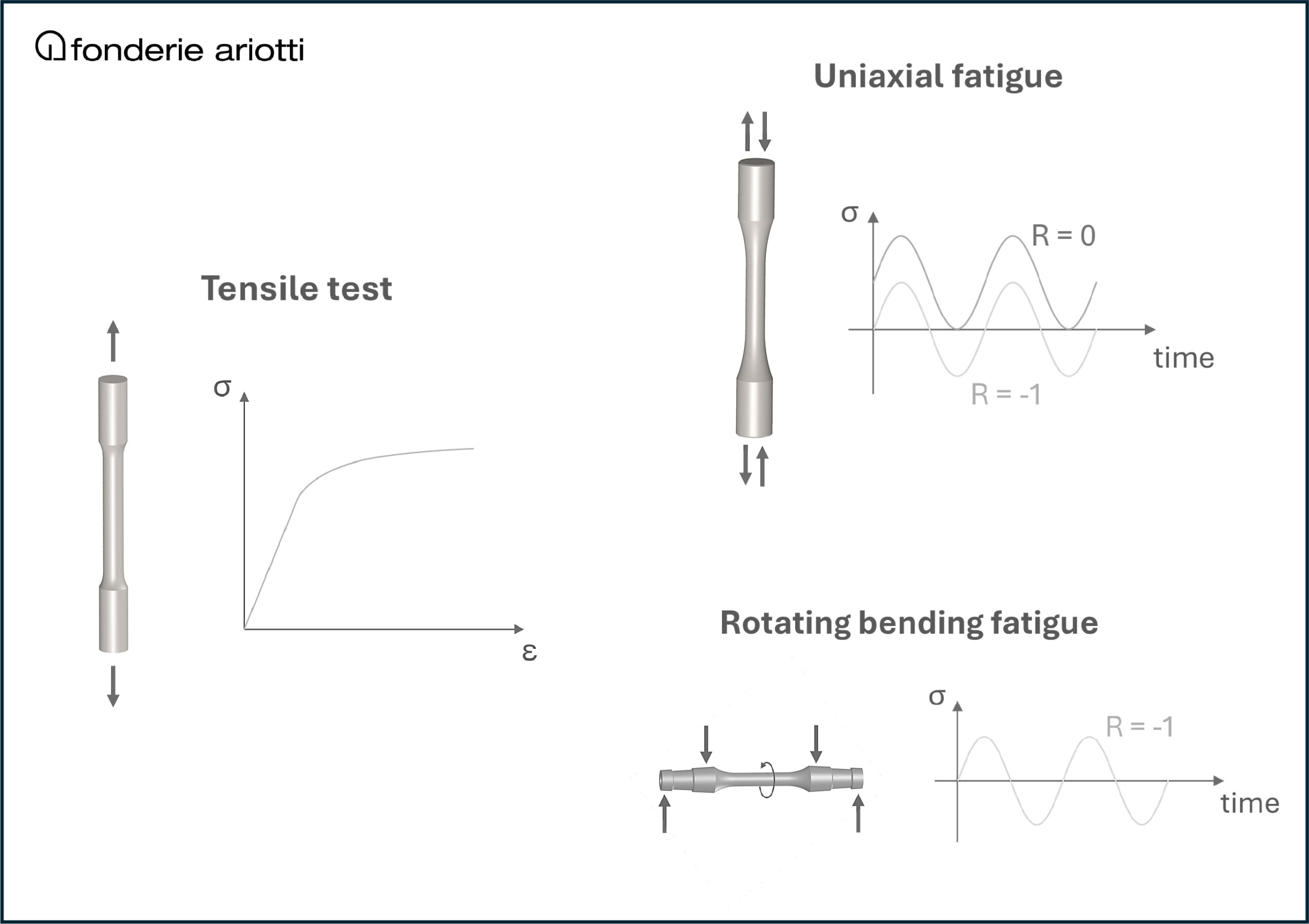
To obtain more representative data, material was cast in different geometries, from standard Y-blocks to large cubes up to 1000 mm, simulating different solidification times and equivalent wall thicknesses. Specimens were then machined and tested through:
- Tensile tests.
- Uniaxial fatigue tests at different load ratios, up to 10 million cycles.
- Rotating bending fatigue tests, up to 10 million cycles
The resulting database is continuously updated and supports co-design activities with customers. By combining casting simulation with experimental data, solidification time can be linked to expected mechanical properties.


Research and development activities – 2026
For 2026, several research initiatives are already underway, focusing on engineering support, manufacturing innovation, and material behaviour in demanding environments.
Finite element analysis for co-design
To strengthen our engineering and co-design capabilities, we recently introduced finite element analysis (FEA) using ANSYS® software.
By combining casting simulation and FEA, we can evaluate solidification behaviour, estimate local material properties using our continuously updated internal database, and analyse stress distribution and deformation under service conditions.
This integrated workflow allows for an initial topological optimisation of the component, enabling us to provide customers with a preliminary geometry, which can be optimised for the foundry process, as a starting point for their final design.

3D-printed cores and moulds
The integration of 3D-printed cores and moulds into the foundry process can significantly reduce time-to-market and enhance the manufacturability of complex geometries. We are currently evaluating the feasibility of this technology to ensure consistently high-quality component production with large dimensions.
High-temperature oxidation studies
For components operating at high temperatures, understanding oxidation behaviour is essential. Current studies focus on analysing the high-temperature oxidation resistance of different cast iron microstructures, with the aim of improving the prediction of material behaviour in demanding service environments.
Doctoral research project on ductile cast iron performance
Fonderie Ariotti has also co-financed a doctoral research project in collaboration with the Industrial Engineering Department of the University of Trento.
The project focuses on the behaviour of thick-walled ductile cast iron components under complex loading conditions and aggressive environments. The main research topics include:
Effect of overloads on the residual fatigue properties of ductile cast iron.
Corrosion-fatigue behaviour of different ductile iron grades, including the influence of cathodic protection and possible over-protection.
Influence of advanced shot blasting techniques on the fatigue performance of thick-walled ductile cast iron components.